Thursday, 17 August 2023
Hydrogen storage without high pressure tanks, but in a liquid with baking soda!
Here’s how it works: Solutions of formate ions (hydrogen and carbon dioxide) in water carry hydrogen based on non-corrosive alkali metal formate. The ions react with water in the presence of a catalyst. That reaction makes hydrogen and bicarbonates the “baking soda” Autrey admires for its absence of environmental impacts.
With the right mild tweaks in pressure, the bicarbonate-formate cycle can be reversed. That provides an on-off switch for an aqueous solution that can alternately store or release hydrogen.
Before baking soda, the PNNL hydrogen storage team looked at ethanol as a liquid organic hydrogen carrier, the industry’s blanket term for storage and transport media. In tandem, they developed a catalyst that releases the hydrogen.
Catalysts are designer additives that speed the processes used to make and break chemical bonds in an energy-efficient way.
In May 2023, for a project related to the PNNL effort, EERE granted OCOchem of Richland, Washington, $2.5 million in funding over two years to develop an electrochemical process that makes formate and formic acid from carbon dioxide. The process would bind carbon dioxide with the hydrogen located in water’s iconic chemical bond, H2O.
In a partnership just starting, PNNL will develop ways to release hydrogen from the OCOchem products.
Hydrogen storage that ‘looks like water’
In the world of hydrogen storage research, the bicarbonate-formate cycle has created a buzz for quite some time. After all, it is based on materials that are abundant, non-flammable, and non-toxic.
The cycle is built on an aqueous storage solution so mild it “looks like water,” said Autrey. “You can put out a fire with it.”
But for formate-bicarbonate salts to become a viable means of storing hydrogen energy, researchers must still develop economically feasible scenarios. So far, the technology stores hydrogen at only 20 kilograms per cubic meter, compared to liquid hydrogen’s industry standard of 70.
More fundamentally, said Autrey, researchers need a systems-level understanding of the required electrochemistry and catalysis. In engineering terms, to date, the idea of a workable bicarbonate-formate cycle has a low technical readiness level.
“If we solve the catalysis problems,” he added, “we could get some real interest.”
‘An amazing shiny thing’
On the plus side, the salt solutions under consideration at PNNL release hydrogen upon reaction with water. They also operate at moderate temperatures and low pressures.
In theory, at least, as Autrey and Gutiérrez describe in their 2023 paper, the bicarbonate-formate cycle represents “a feasible green alternative for storing and transporting energy” from hydrogen.
The baking soda idea is also at the nexus of what the 2023 paper calls “several urgent scientific challenges.”
Among them are how to make a hydrogen storage media from captured excess carbon dioxide. And even to use the same media to store electrons, which offers the promise of direct formate fuel cells.
In addition, the PNNL work could provide insights for catalysis in the aqueous (water) phase. For now, the PNNL team is using palladium as their candidate catalyst. Their efforts include finding ways to make the rare metal more stable, reusable, and longer-lived.
All in all, the baking soda idea “is this amazing shiny thing” for hydrogen storage, said Autrey. “What’s exciting are the possibilities.”
***
https://oilprice.com/Energy/Energy-General/Simple-Kitchen-Ingredient-Might-Revolutionize-Hydrogen-Storage.html

Tuesday, 8 August 2023
Cooling without compressors, blowers, or noise was perfected in Iran, now used in Seville
The structure is a part of CartujaQanat, an architectural experiment in cooling solutions that doesn’t rely on burning more planet-warming fossil fuels. The site, about the size of two soccer fields, includes two auditoriums, green spaces, a promenade and a shaded area with benches. But its star performer remains hidden — the qanat, a network of underground pipes and tubes inspired by Persian-era canals.
The CartujaQanat project in Seville is sitting in limbo as administrative and technical hurdles have delayed its opening Photographer: Àngel García/Bloomberg
The grid of aqueducts can lower surrounding temperatures by as much as 10C using just air, water and solar power, according to Emasesa, the Seville public water company that helped to build it. The system is modeled on ancient tunnels dug to bring water to agricultural fields that were first documented in what is today Iran. The Persians realized 1,000 years ago that the running water also cooled the air in the canals, so they fashioned vertical shafts to bring that air to the surface.
“This is not an air-conditioning system like the one you may have in your home,” says Juan Luis López, the project’s supervisor and an engineer at Emasesa. “We use natural techniques and materials to reduce temperatures.”
The CartujaQanat was designed by researchers at Universidad de Sevilla, who added some modern twists to the Persian engineering marvel that served as its inspiration.
At night, water runs through an aqueduct outside, which takes it over solar panels on the roof and into giant tanks underground. Contact with the lower temperatures cools the water, while the closed circuit minimizes waste. When the day starts to get hot, solar-powered pumps push the same water through small pipes that run in front of fans to generate cold air. Small openings in the floor and steps allow the refreshing current to seep into the square.
The square itself has features that make sure temperatures inside are lower even when the qanat system isn’t operating. It sits two (6.5 feet) underground, is covered by a white heat-reflecting roof and surrounded by columns and vegetation that help cool it down.
read the rest here:
https://www.bloomberg.com/features/2023-seville-spain-extreme-heat/?cmpid=BBD080823_GREENDAILY
Saturday, 1 July 2023
Geothermal energy from lower heat sources makes it much more cost effective with Sage Geosystems.com
No longer do we need to pump water deep in the ground, this system is closed loop and does not consume any water!
Sage deploys an enhanced geothermal system using a combination of off-the-shelf oilfield equipment and proprietary technology to capture geothermal power from any underground formation where the required heat level exists. The beauty of this approach is that the oil and gas industry has been drilling into many suitable formations for decades now, and that project execution requires the same basic fields of expertise used in the oil and gas business since its inception.
The next challenge, she says, comes in determining “how do you cost effectively then harvest that heat out of the earth and then bring it to the surface, and then cost effectively convert that heat to electricity? That's the challenge that the geothermal industry has faced for about 40 years.”
Once the well is drilled into the target formation (the process can even sometimes tap into pre-existing wellbores, thus cutting costs), Sage then deploys what Taff calls a “cycle of injection and production” similar to “huff and puff” pumping systems used by the oil and gas industry for many years.
here is the link:
https://www.forbes.com/sites/davidblackmon/2023/06/29/is-geothermal-the-magic-bullet-for-renewable-baseload/
the company is called Sage Geosystems,
here is an interview with the CEO, :
https://www.sagegeosystems.com/geothermal-talks-empowering-the-future-with-david-blackmons-podcast/
Wednesday, 15 March 2023
Saturday, 4 February 2023
Forget all those expensive, exotic technologies, we already have the tools to live sustainably!
“Combustion is the problem – when you’re continuing to burn something, that’s not solving the problem,” says Prof Mark Jacobson.
The Stanford University academic has a compelling pitch: the world can rapidly get 100% of its energy from renewable sources with, as the title of his new book says, “no miracles needed”.
Wind, water and solar can provide plentiful and cheap power, he argues, ending the carbon emissions driving the climate crisis, slashing deadly air pollution and ensuring energy security. Carbon capture and storage, biofuels, new nuclear and other technologies are expensive wastes of time, he argues.
“Bill Gates said we have to put a lot of money into miracle technologies,” Jacobson says. “But we don’t – we have the technologies that we need. We have wind, solar, geothermal, hydro, electric cars. We have batteries, heat pumps, energy efficiency. We have 95% of the technologies right now that we need to solve the problem.” The missing 5% is for long-distance aircraft and ships, he says, for which hydrogen-powered fuel cells can be developed.
Jacobson’s claim is a big one. He is not just talking about a shift to 100% renewable electricity, but all energy – and fossil fuels still provide about 80% of that today. Jacobson has scores of academic papers to his name and his work has been influential in policies passed by cities, states and countries around the world targeting 100% green power. He is also controversial, not least for pursuing a $10m lawsuit against researchers who claimed his work was flawed, which he later dropped.
https://www.theguardian.com/environment/2023/jan/23/no-miracles-needed-prof-mark-jacobson-on-how-wind-sun-and-water-can-power-the-world?CMP=share_btn_tw
Thursday, 2 February 2023
GM parts with LG, stops using pouch cells, switches to 4680, like BMW!
https://cleantechnica.com/2023/01/28/gm-switching-to-cylindrical-battery-cells/
A report by South Korea’s TheElec claims that General Motors is planning to stop using pouch cells in its future electric cars and switch to cylindrical cells. The move has caused some stress in the relationship between GM and its primary battery supplier, LG Energy Solution. The two companies are have already agreed to jointly construct and operate three battery factories in the US. One is already in operation in Ohio and two others are under construction — one in Michigan and the other in Tennessee.
A fourth factory was planned for Indiana, but this latest decision seems to have put that plan on hold. The talks between GM and LGES about that plant have ended, sources tell TheElec, and GM is reportedly reaching out to at least one other battery manufacturer, as yet unnamed.
There are precious few details available but the information TheElec got from its sources in South Korea is that General Motors will use the 4680 format cylindrical cells first used by Tesla. Cylindrical cells may be somewhat easier to manufacture than pouch cells, since the production techniques have been in use since the Carter administration, which could make them a lower cost option at a time when battery materials prices are rising.
Sunday, 22 January 2023
Saturday, 7 January 2023
Net Zero hotel reno, of a classic brutalist building designed by Marcel Breuer
Kone elevators use the gravity of cars descending to generate power like automotive regen, also energy storage with weights csan be utilised during peak power periods.
All lighting for a 200 room hotel only draws 5000W, since they use low voltage DC power direct from the solar panels or battery, sent to each room on cat 6 power over ethernet!
no power wasted with a transformer in each bulb!
nice power roll down blinds controlled from bedside.
very nicely done dining area, all cooking is done on induction cooking ranges.
Friday, 16 December 2022
Salt and sulphur is the new battery chemistry to claim high capacity.
Australians claim it could have four times the power per volume than lithium!
Electric viking has a youtube thing on it here!
https://youtu.be/xodNEVG4baA
another video from just have a think:
https://youtu.be/cHNELRnJ_4Y
Friday, 28 October 2022
Iron flow batteries with 25 year life and 4 to 10 hour duration
Iron flow batteries provide a long duration energy storage solution suited Australia's resource availability and harsh climate.
ESS technology uses the abundant low-cost elements of iron, salt, and water to deliver environmentally safe battery solutions capable of providing up to 12 hours of flexible utility-scale energy storage. From sundown to sunup!
“ESS iron flow technology provides cost-effective long-duration energy storage and is ideal for applications that require from 4–12 hours of flexible energy capacity. ESS systems provide resilient, sustainable energy storage well-suited for multiple use cases including utility-scale renewable energy installations, remote solar + storage microgrids, grid load-shifting and peak shaving, and other ancillary grid services. ESS technology is safe, non-toxic and has a 25-year lifespan without capacity fade. Demand for long-duration energy storage systems is expected to grow rapidly in Australia; New South Wales announced the procurement of 2 GW of LDES in its recent Electricity Infrastructure Roadmap.”
Stuart Parry, Managing Director of ESI, says: “Safe and non-toxic ESS iron flow batteries are perfect in Australia’s harsh environment and the ability to locally source electrolyte provides insurance against supply chain risks and price escalation. The transition to clean energy requires new long-duration storage solutions and we look forward to working with ESS to meet the needs of an increasingly renewable energy grid.”
read the whole story here;
https://cleantechnica.com/2022/10/27/iron-flow-batteries-to-be-built-in-queensland/
Tuesday, 25 October 2022
Canada commits C$970 million to new nuclear power technology from GE/Hitachi for small nuclear reactor
Does he not know that this is no panacea, just more nuclear wasdte than the big reactors..
It might be great to generate heat for the tarsands to cook the tar out of the sand, but then we are left with even more polluted residue, and guess who ends up dealing with aftermath, yes, the taxpayer, just like all those abandoned oil and gas wells..
Read more about how these bold plans for small nuclear teactors make it harder to placed their wate in geological safe storege places, here;
https://www.pnas.org/doi/10.1073/pnas.2111833119
exerpt:
Small modular reactors (SMRs), proposed as the future of nuclear energy, have purported cost and safety advantages over existing gigawatt-scale light water reactors (LWRs). However, few studies have assessed the implications of SMRs for the back end of the nuclear fuel cycle. The low-, intermediate-, and high-level waste stream characterization presented here reveals that SMRs will produce more voluminous and chemically/physically reactive waste than LWRs, which will impact options for the management and disposal of this waste. Although the analysis focuses on only three of dozens of proposed SMR designs, the intrinsically higher neutron leakage associated with SMRs suggests that most designs are inferior to LWRs with respect to the generation, management, and final disposal of key radionuclides in nuclear waste.
Abstract
Small modular reactors (SMRs; i.e., nuclear reactors that produce <300 MWelec each) have garnered attention because of claims of inherent safety features and reduced cost. However, remarkably few studies have analyzed the management and disposal of their nuclear waste streams. Here, we compare three distinct SMR designs to an 1,100-MWelec pressurized water reactor in terms of the energy-equivalent volume, (radio-)chemistry, decay heat, and fissile isotope composition of (notional) high-, intermediate-, and low-level waste streams. Results reveal that water-, molten salt–, and sodium-cooled SMR designs will increase the volume of nuclear waste in need of management and disposal by factors of 2 to 30. The excess waste volume is attributed to the use of neutron reflectors and/or of chemically reactive fuels and coolants in SMR designs. That said, volume is not the most important evaluation metric; rather, geologic repository performance is driven by the decay heat power and the (radio-)chemistry of spent nuclear fuel, for which SMRs provide no benefit. SMRs will not reduce the generation of geochemically mobile 129I, 99Tc, and 79Se fission products, which are important dose contributors for most repository designs. In addition, SMR spent fuel will contain relatively high concentrations of fissile nuclides, which will demand novel approaches to evaluating criticality during storage and disposal. Since waste stream properties are influenced by neutron leakage, a basic physical process that is enhanced in small reactor cores, SMRs will exacerbate the challenges of nuclear waste management and disposal.
Sign up for PNAS alerts.
Wednesday, 16 March 2022
Nickel hydrogen batteries long lasting and dependable
Hubble Space telescope used them for 19 years before replacement!
more from wikipedia, here is the highlights;
The nickel-hydrogen battery combines the positive nickel electrode of a nickel-cadmium battery and the negative electrode, including the catalyst and gas diffusion elements, of a fuel cell. During discharge, hydrogen contained in the pressure vessel is oxidized into water while the nickel oxyhydroxide electrode is reduced to nickel hydroxide. Water is consumed at the nickel electrode and produced at the hydrogen electrode, so the concentration of the potassium hydroxide electrolyte does not change. As the battery discharges, the hydrogen pressure drops, providing a reliable state of charge indicator. In one communication satellite battery, the pressure at full charge was over 500 pounds/square inch (3.4 MPa), dropping to only about 15 PSI (0.1 MPa) at full discharge.
If the cell is over-charged, the oxygen produced at the nickel electrode reacts with the hydrogen present in the cell and forms water; as a consequence the cells can withstand overcharging as long as the heat generated can be dissipated.[dubious – discuss]
The cells have the disadvantage of relatively high self-discharge rate, i.e. chemical reduction of Ni(III) into Ni(II) in the cathode:
{\displaystyle {\ce {NiOOH + 1/2H2 <=> Ni(OH)2.}}}{\displaystyle {\ce {NiOOH + 1/2H2 <=> Ni(OH)2.}}}
which is proportional to the pressure of hydrogen in the cell; in some designs, 50% of the capacity can be lost after only a few days' storage. Self-discharge is less at lower temperature.[1]
Compared with other rechargeable batteries, a nickel-hydrogen battery provides good specific energy of 55-60 watt-hours/kg, and very long cycle life (40,000 cycles at 40% DOD) and operating life (> 15 years) in satellite applications. The cells can tolerate overcharging and accidental polarity reversal, and the hydrogen pressure in the cell provides a good indication of the state of charge. However, the gaseous nature of hydrogen means that the volume efficiency is relatively low (60-100 Wh/L for an IPV (individual pressure vessel) cell), and the high pressure required makes for high-cost pressure vessels.[1]
The positive electrode is made up of a dry sintered[20] porous nickel plaque, which contains nickel hydroxide. The negative hydrogen electrode utilises a teflon-bonded platinum black catalyst at a loading of 7 mg/cm2 and the separator is knit zirconia cloth (ZYK-15 Zircar).[21][22]
The Hubble replacement batteries are produced with a wet slurry process where a binder agent and powdered metallic materials are molded and heated to boil off the liquid.[23]
Designs
Individual pressure vessel (IPV) design consists of a single unit of NiH2 cells in a pressure vessel.[24]
Common pressure vessel (CPV) design consist of two NiH2 cell stacks in series in a common pressure vessel. The CPV provides a slightly higher specific energy than the IPV.
Single pressure vessel (SPV) design combines up to 22 cells in series in a single pressure vessel.
Bipolar design is based on thick electrodes, positive-to-negative back-to-back stacked in a SPV.[25]
Dependent pressure vessel (DPV) cell design offers higher specific energy and reduced cost.[26]
Common/dependent pressure vessel (C/DPV) is a hybrid of the common pressure vessel (CPV) and the dependent pressure vessel (DPV) with a high volumetric efficiency.[27]
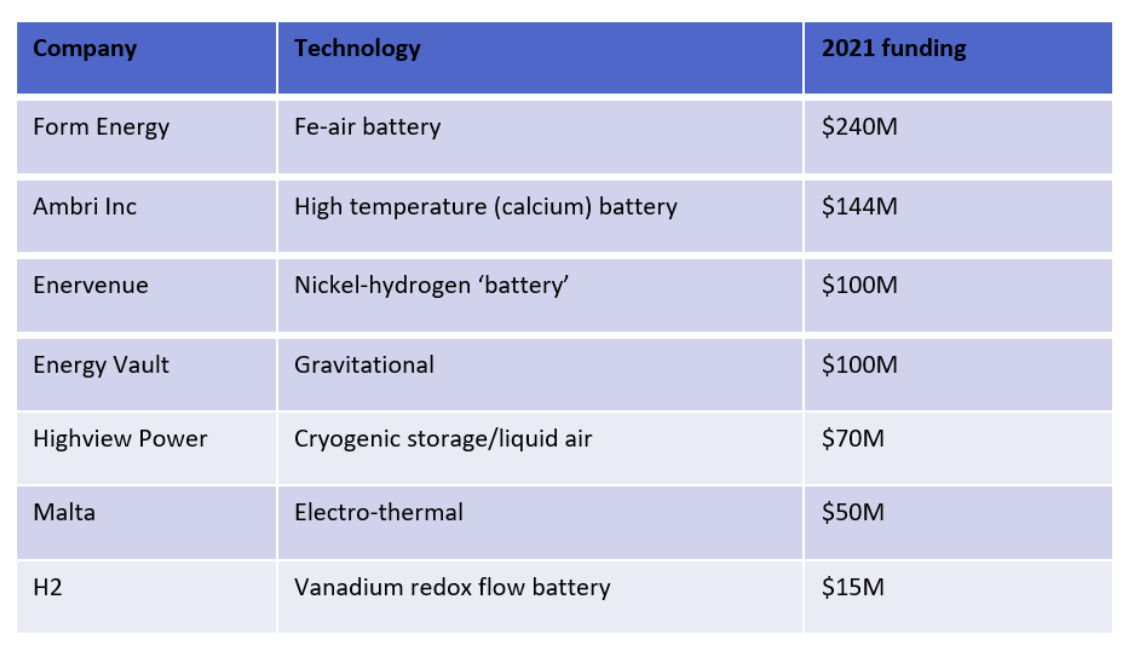
alternatives to lithium batteries are lower cost, longer duration
Subscribe to:
Posts (Atom)